Every number on this page was produced by the quality bench in bench/
and can be checked against the files in bench/results/: the shipped
GLBs under 1 MB, renders, production logs and per-run JSON. Nothing is estimated unless it
says so. Where a result is unflattering, it stays.
How it is measured
Sessions. Each brief runs as one headless Claude Code session (claude -p, Opus 5.5), with
no user settings, a throwaway Blender profile and a pinned MCP server. The skill is interactive,
so every parameter it would ask for is given up front; its auto mode does the rest.
The file, not the log. Each shipped *_final.glb is re-imported into Blender and measured
by bench/measure.py: triangles, fused (non-manifold) edges, grounding,
textures that survived export, rig structure and a deformation probe. The session's own report
is never the source of a number.
Against a photo. plugin/tools/fidelity_check.py, also used by the
skill itself, renders the model at the photo's angle under a Poly Haven studio HDRI and compares
silhouette and material per height band. It is tested on seeded inputs
(plugin/tools/test_fidelity_check.py, 27/27).
Against the truth. The photo references are Poly Haven previews (CC0), so the real 3D asset
exists. bench/gt_compare.py scores each reconstruction against it from
front, back, left, right and top, finds the model's orientation, and reports its real size. A
session never sees the truth, it works from the photo, as a user would. The truth is the
marking scheme.
In a sandbox. Since 2026-10-01 every session runs outside every repository, with only the files its brief names and the skill's runtime files, and its transcript is audited for any call reaching the results, the truth or the repositories (§ 8).
Cost is the CLI's API-equivalent figure (total_cost_usd). On a Claude subscription it is
not billed; it is the comparable measure of how much a run consumes.
1. Before and after: six briefs, two Blender MCP servers
Six fixed briefs, one per pipeline path, scripted modeling, AI generation, a PolyHaven import, PBR texturing, a rigged character, batch mode. Skill 1.1.2 against the current branch, Blender 5.2.2, one run per brief.
| Five briefs without AI | ahujasid's MCP, before → after | Official Blender Lab MCP, before → after |
|---|---|---|
| Shipped size | 32.85 MB → 0.96 MB (÷34) | 3.87 MB → 0.75 MB (÷5) |
| GLBs compressed (Draco / WebP) | 0 of 7 → 7 of 7 | 0 of 7 → 7 of 7 |
| Defects the measure found | 2 → 1 (a stool 6 mm below the ground) | 2 → 0 |
| Cost for the five | $6.49 → $7.34 (+13 %) | $5.82 → $7.81 (+34 %) |
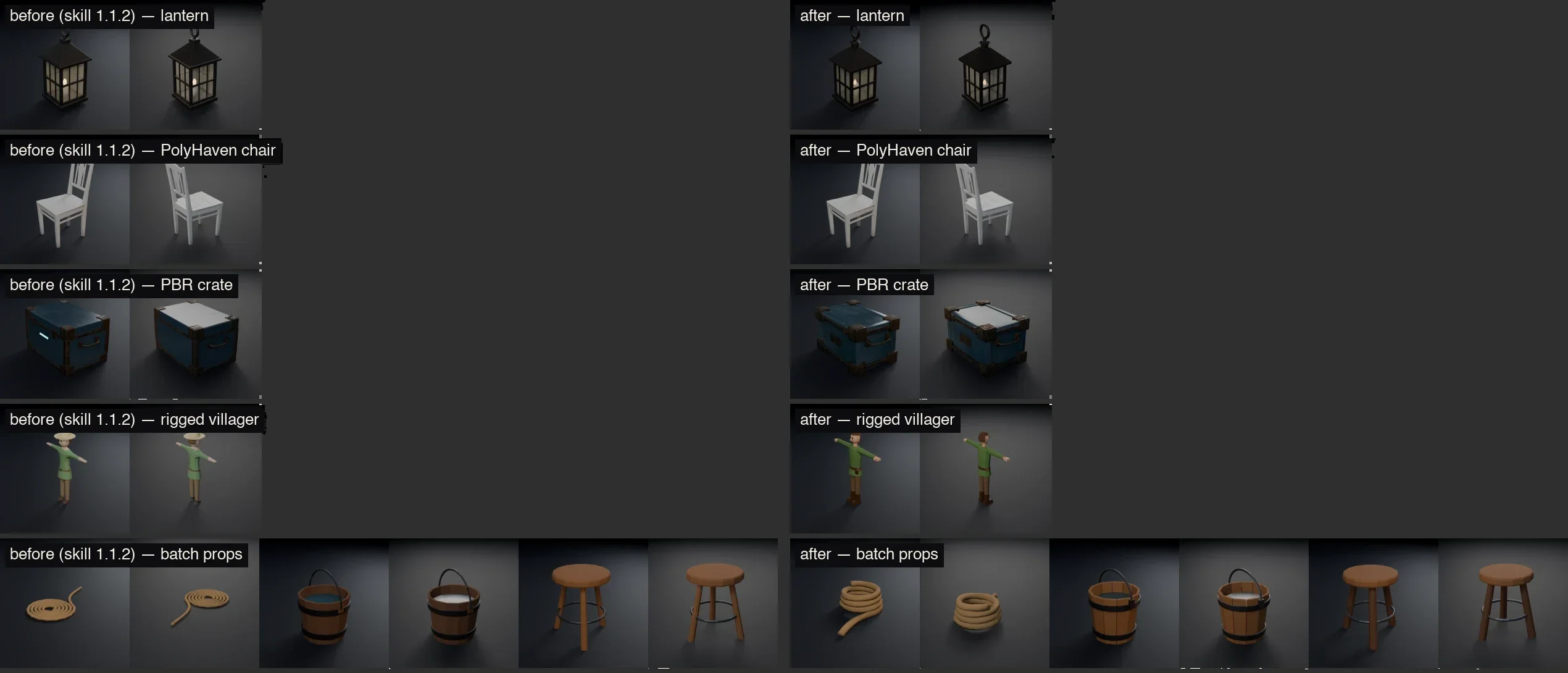
Left half: before (skill 1.1.2) · right half: after. One row per brief, lantern, PolyHaven chair, PBR crate, rigged villager, batch props, each object rendered from two angles under the same studio light. The Lab MCP's sheet: before-after-lab.webp.

No visual regression on either server. The skill now does the work it used to skip - optimization, validation, re-checks, and pays for it in turns.
The AI brief ships no GLB, before or after, by design. Generation works (Hunyuan3D's Space, 275,000 triangles); the session then proposes decimation options with previews and waits for the user, rule 6, never destroy silently. A headless run cannot answer. Both sessions also flagged, unprompted, that Hunyuan3D's licence excludes the EU.
Details: bench/results/final/.
2. The two Blender MCP servers, same skill
Skill 1.1.2 unchanged, six briefs on each server.
| ahujasid 2.0.0 | Official Blender Lab MCP | |
|---|---|---|
| GLBs shipped | 7 | 7 |
| Cost ≈ | $7.74 | $6.99 (−10 %) |
| Turns | 197 | 136 |
| Fused edges shipped | 0 | 84 (one lantern) |
kiln runs on the Blender Foundation's server, the one behind Claude's Blender connector -
with no change: sessions mapped the tool names themselves and reached PolyHaven through its
public API when the server had no PolyHaven tools. The skill now documents both paths.
Details: bench/results/mcp-comparison-2026-09-29.md.
3. From a photo: fifteen iterations on one lantern
One reference, Poly Haven's Lantern_01 preview, photographed from about 15° above, and the
same brief each time. Each version is the skill after the previous one's findings.
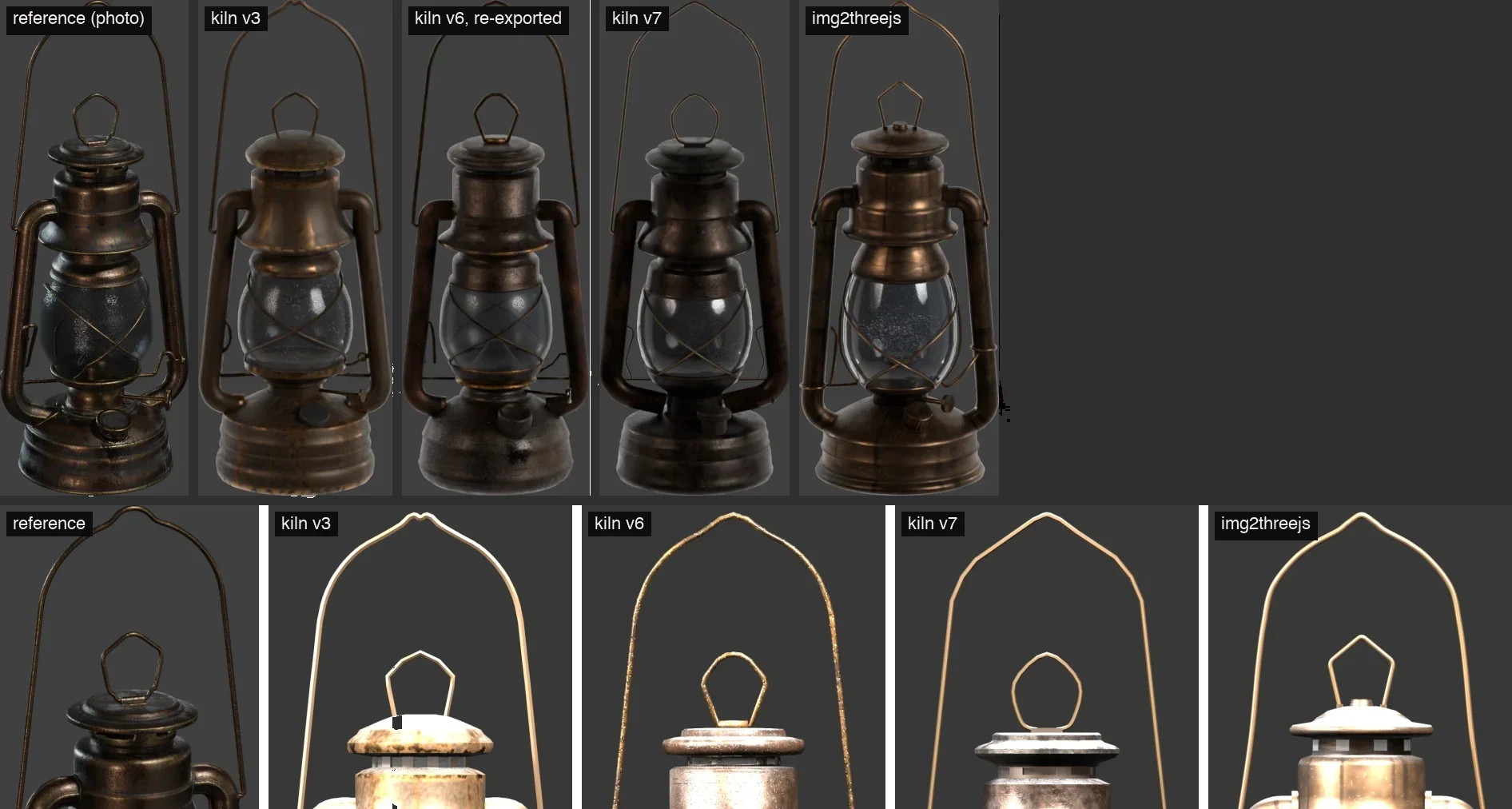
Top row, left to right: the reference photo · kiln v3 · kiln v6 re-exported · kiln v7 · img2threejs, all rendered at the photo's ~15° angle under the same studio HDRI. Bottom row: the same versions, close-up on the bail and top loop (the reference crop on the left). Every version up to v6: lantern-iterations/.
| truth, 5 views | height vs real | saturation (ref 0.32) | tris | cost | |
|---|---|---|---|---|---|
| v1: before the loop | 0.830 | +23 % | 0.44 | 6,852 | $1.90 |
| v3: measured review | 0.876 | +33 % | 0.34 | 10,688 | $2.83 |
| v4: traced wires, layered textures | 0.843 | +29 % | 0.33 | 8,044 | $4.06 |
| v5: size and camera angle | 0.848 | +2 % | 0.38 | 8,572 | $5.63 |
| v6: as shipped | 0.862 | +2 % | 0.12 | 8,836 | $4.15 |
| v7: sRGB export fix | 0.861 | +2 % | 0.31 | 7,552 | $3.52 |
What each step taught is in What the measurements taught. Two versions are worth reading closely:
- v4 fitted the photo best (0.898) and the real object worse than v3. It had copied the photo's perspective into the geometry: a base 30 % too tall. A photo score above what the real object itself scores (~0.80) is overfitting, not progress.
- v6 was reviewed at the right colour and shipped near black. Blender's glTF exporter writes a linear float base-colour image into its PNG without the sRGB transfer (linear 0.2 becomes byte 51, not 124). Re-exported through a conversion, the same file reads 0.30.
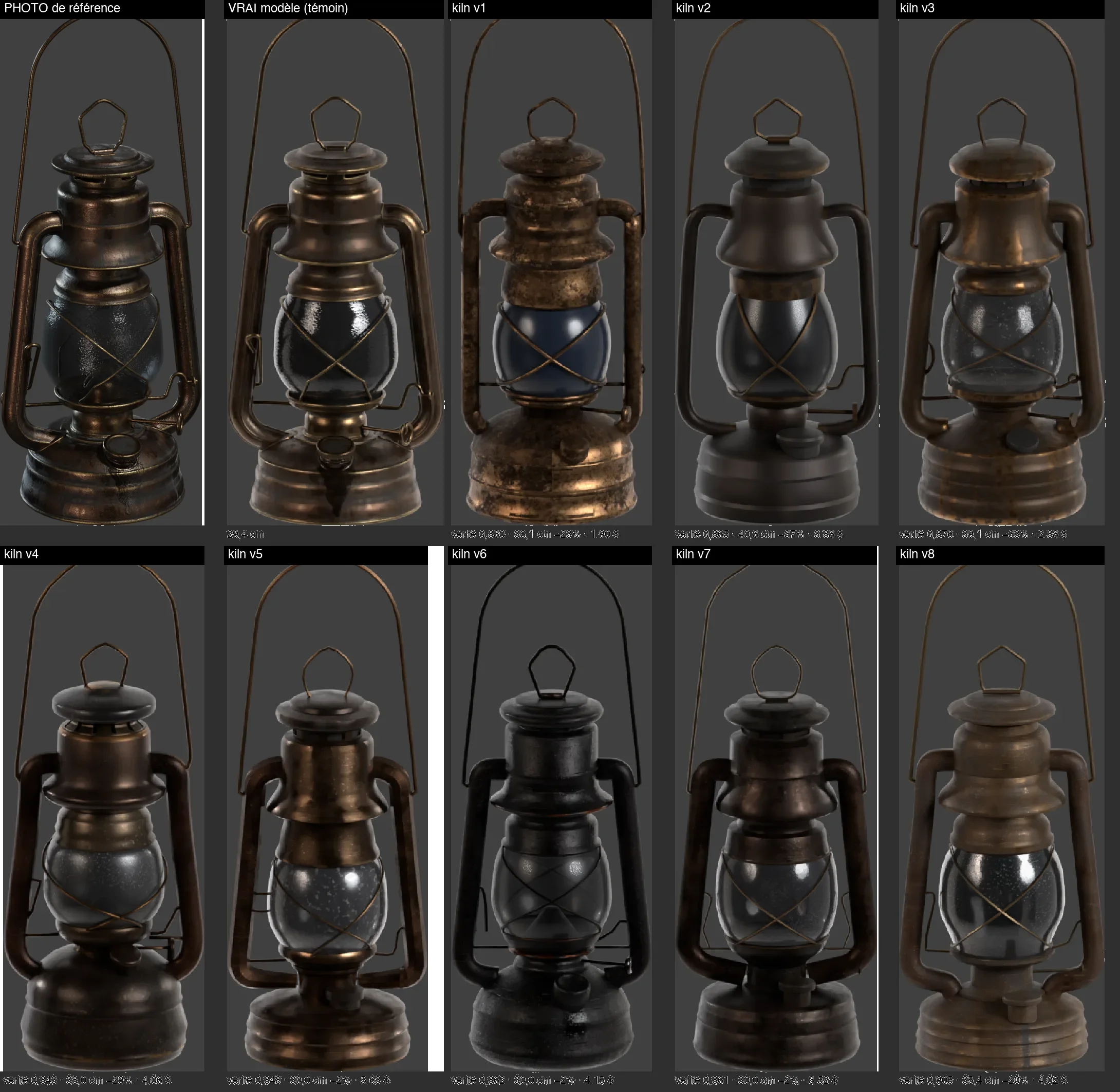
Top row: the reference photo · the real Poly Haven asset (the witness, never shown to a session) · kiln v1 · v2 · v3. Bottom row: v4 · v5 · v6 · v7 · v8. Same studio HDRI, same 15° camera; truth score, height and cost under each.
v8 to v15: from the right shape to a believable surface
v7 had the right size and silhouette and read near-black. Eight more versions, re-measured together at one render setting (so their detail figures do not compare with the table above):
| truth, 5 views | base share (real 13.9 %) | what changed in the skill | cost | |
|---|---|---|---|---|
| v8 | 0.905 | −24 % | dark metal reported | $4.02 |
| v9 | 0.921 | −6 % | + a TRELLIS.2 mesh as measuring template | $5.19 |
| v10 | 0.914 | −4 % | metal mask: one soft region, no confetti | $4.52 |
| v11 | 0.897 | +1 % | joints rendered and looked at; patina stays metal; one material per metal | $7.64 |
| v12 | : | contaminated: read the bench's results (§ 8) | $8.43 | |
| v13 | 0.924 | +1 % | widths from the template; glass tinted from the photo; sandboxed | $5.63 |
| v14 | 0.880 | +11 % | every figure from this lantern removed from the skill | $5.29 |
| v15 | 0.897 | −1 % | scanned CC0 texture sets before procedural noise | $5.04 |
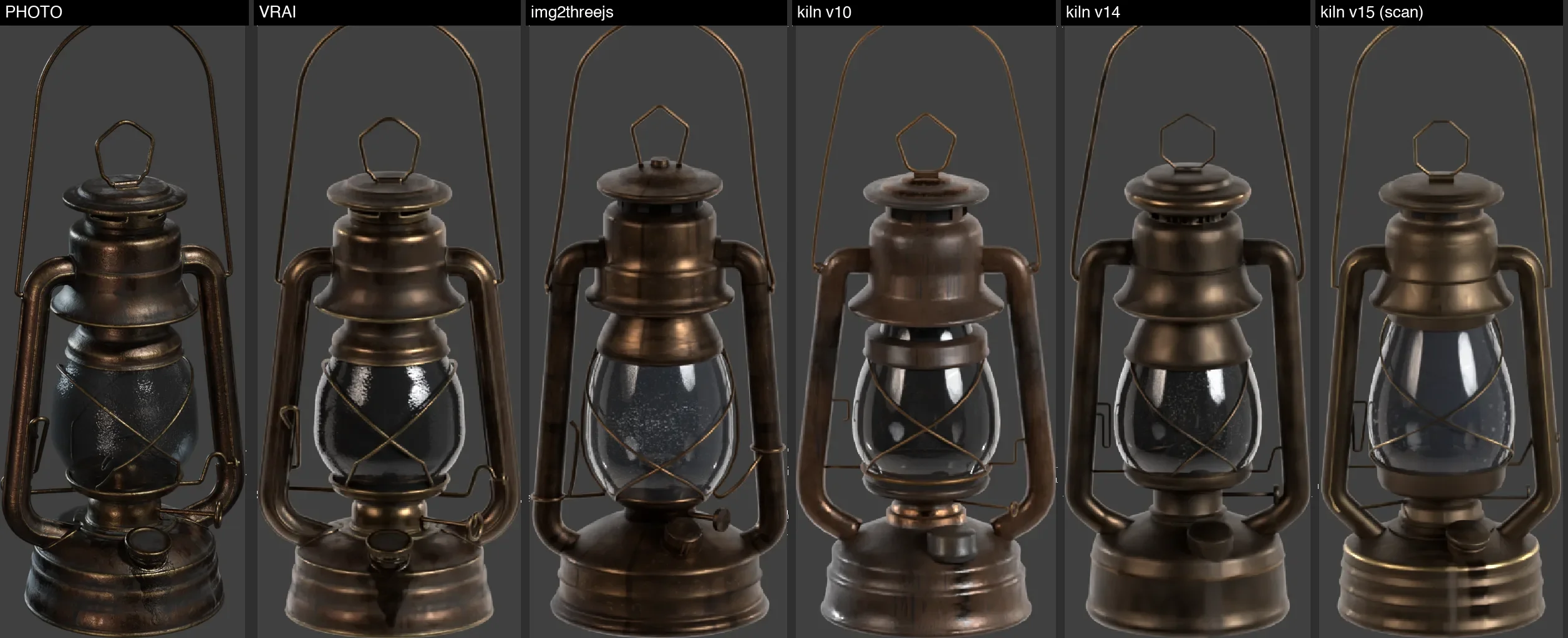
Left to right: the reference photo · the real asset · img2threejs · kiln v10 · kiln v14 · kiln v15 (scanned texture sets). Close-ups of the tank: v15-closeups.webp.

The shape settled early; the surface took the rest. Each texture fix had a side effect the next version paid, dark metal reported → confetti; patina as non-metal → grey pewter; patina as metal → a bronze that looked new; a "shaped foot" for joints → tubes flared into tongues. Two findings changed the method rather than the rules:
- A figure in the skill becomes a target. The references quoted the real lantern's values as illustrations. Sessions aimed at them: its metal share, its height (copied as an "assumption"), its brass's base colour (logged by v11 and v13 as "the doc's real brass is 0.30"). With every such figure removed (v14), the maps finally varied like the real object's.
- Noise makes a smear where a scan has flakes, pits and chips. v15 starts from a Poly Haven texture set chosen by its thumbnail against the photo's crop, and on the crate and the chair (§ 5) that is what made rust and wood read as rust and wood. Brass has no scan; the lantern gained less.
Details: bench/results/lantern-iterations/.
4. kiln against an image-to-code tool
img2threejs (Apache-2.0) rebuilds a reference
image as procedural Three.js code, through eight vision-reviewed passes. Same reference image,
same instruction; its code was exported to GLB by the bench with Three.js's GLTFExporter.
Measured against v7 (later versions in § 3):
| Lantern | kiln v7 | img2threejs |
|---|---|---|
| truth, 5 views | 0.861 | 0.866 |
| height vs real | +2 % | +52 % |
| texture detail (ref 0.032) | 0.018 | 0.026 |
| triangles | 7,552 | 41,736 |
| cost | $3.52 | ≈ $10, stopped after pass 3 of 8 |
Likeness is comparable; img2threejs keeps the edge on fine surface detail, kiln on size, weight and cost, about 2.8× cheaper against a run that was a third done. Its cost is estimated: the run was stopped, and its tokens were priced with rates fitted on 28 kiln sessions of known cost (max error 9.7 %). kiln integrates none of its code; several of its techniques, traced wires, layered texture fields, a frosted-glass recipe, were measured and adopted.
5. Does it generalise: a crate and a chair
The lantern loop could have fitted the skill to one lantern. The same skill, before and after, on two other Poly Haven references:
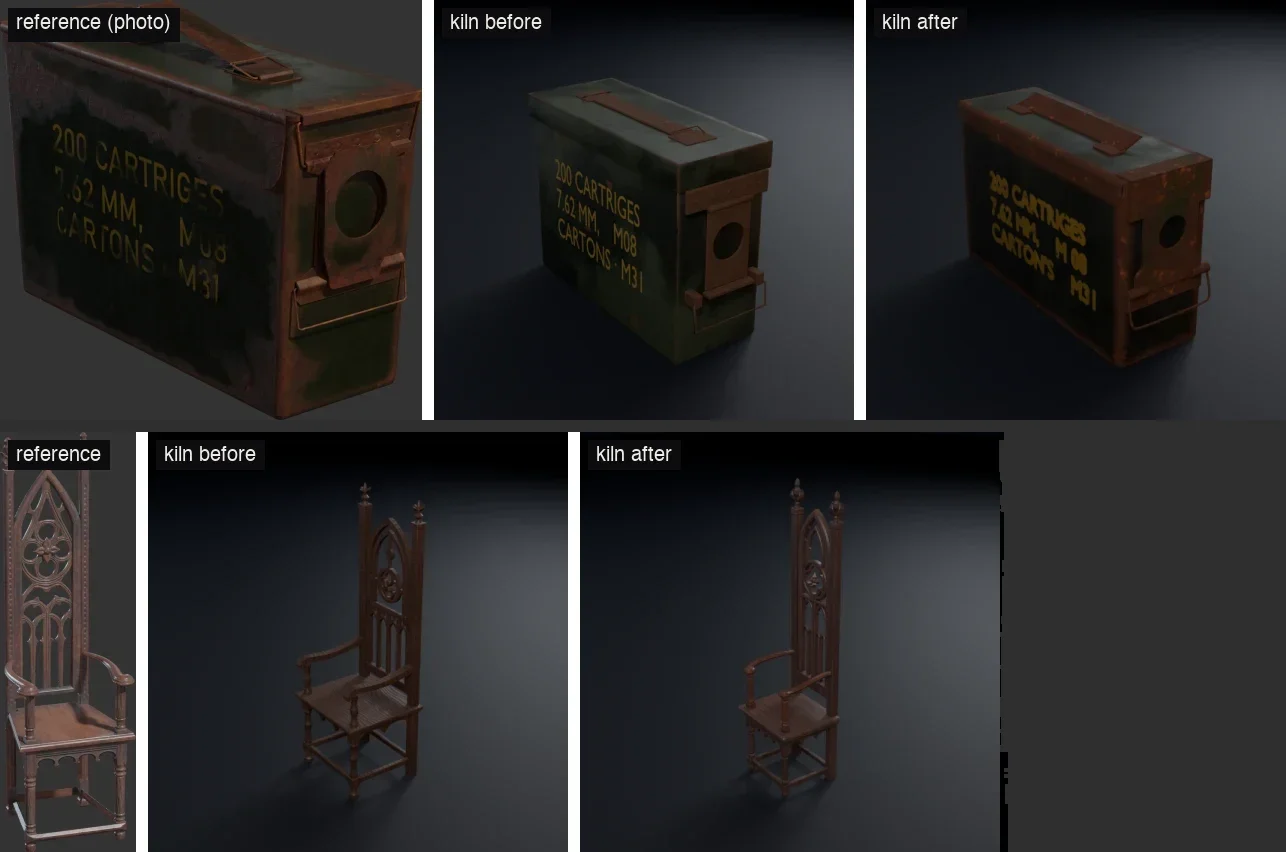
Left to right: the reference photo · kiln before the lantern loop · kiln after. Top: Poly Haven's ammo_box. Bottom: Poly Haven's WoodenChair_01.
| truth | height vs real | cost | |
|---|---|---|---|
| ammo box, before | 0.854 | +30 % | $1.97 |
| ammo box, after | 0.888 | +8 % | $3.10 |
| gothic chair, before | 0.445 | −22 % | $1.94 |
| gothic chair, after | 0.673 | −8 % | $4.41 |
The chair's back now carries the reference's pointed arch, rose and tracery; it is still 11-16 % too narrow and shallow. Its side views are left out of its score: an openwork object seen from the side is thin posts, and every orientation of a good reconstruction overlaps 0.12-0.16 there.
With the final skill (scanned texture sets, 66e0b08)
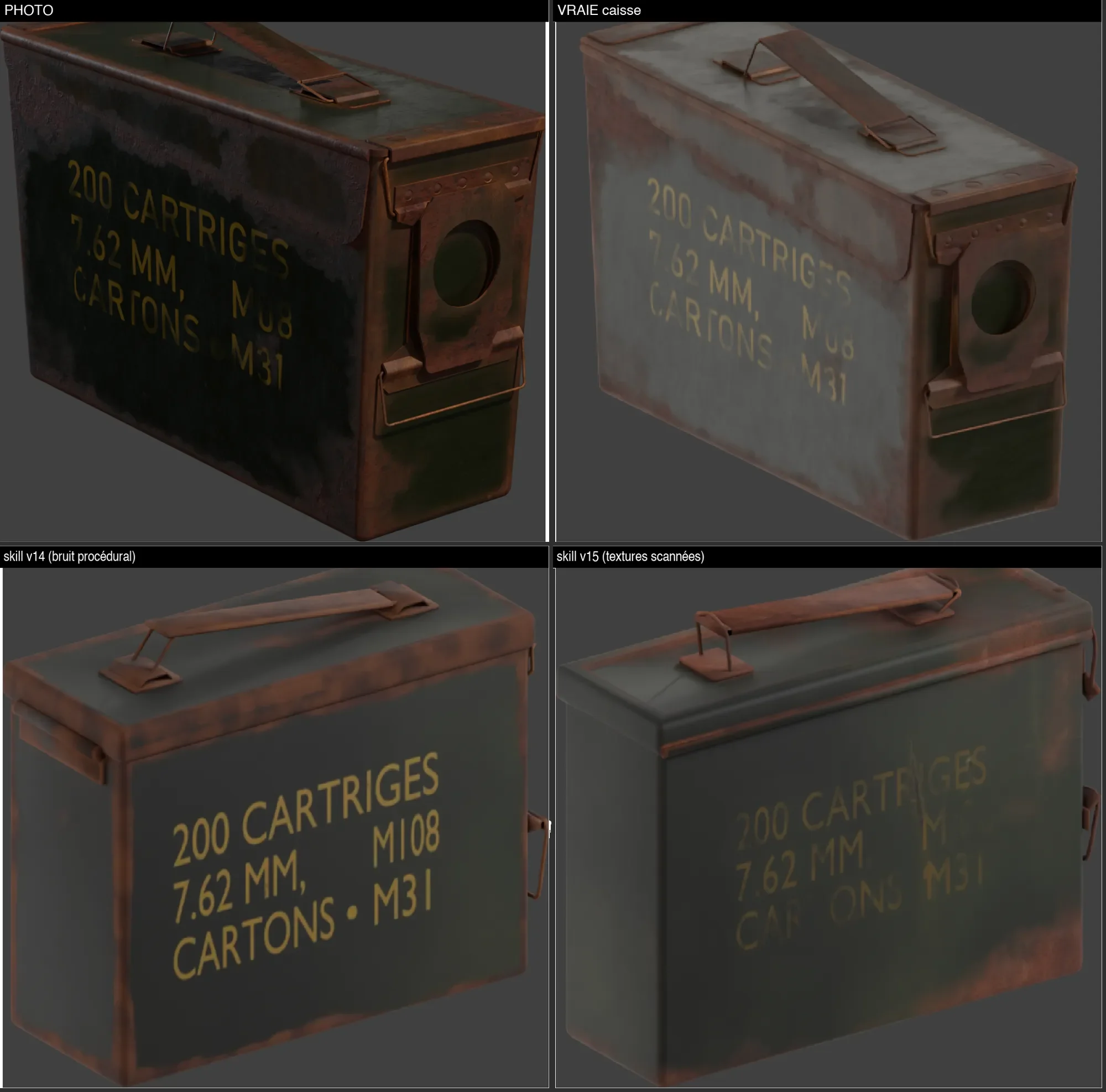
Top: the reference photo · the real asset. Bottom: kiln with procedural noise (v14 skill) · kiln with scanned texture sets (v15 skill).
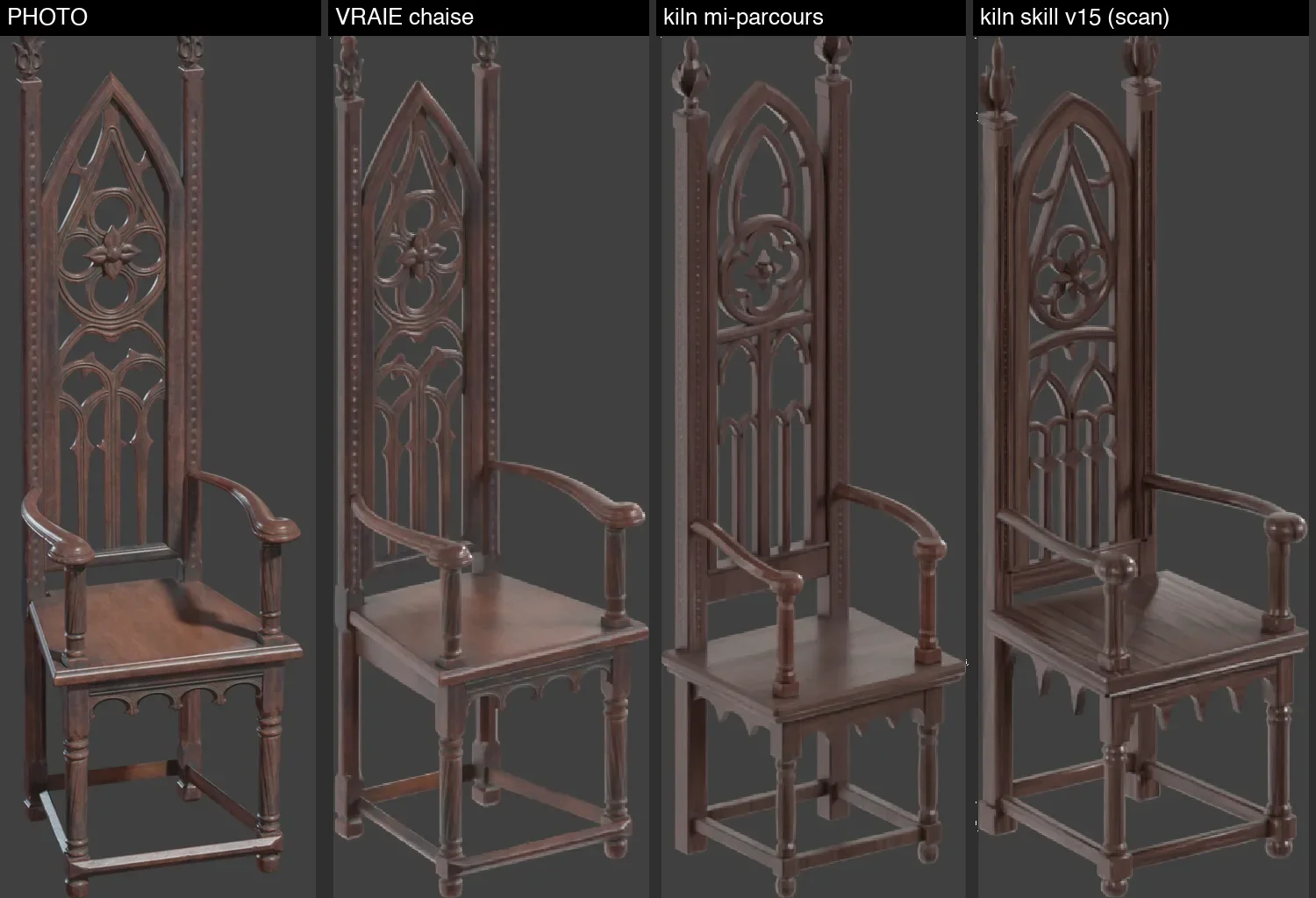
Left to right: the reference photo · the real asset · kiln mid-way · kiln with scanned texture sets.
| truth | proportions | material | cost | |
|---|---|---|---|---|
| ammo box, procedural noise (v14 skill) | 0.878 | base share +1 % | painted steel, rust a soft orange gradient | $4.34 |
| ammo box, scanned sets | 0.950 | base share −1 % | worn paint, broken stencil, rust along the seams | $3.80 |
| gothic chair, scanned sets | 0.750 | depth/height exact, width/height +10 % | one mahogany from dark_wood, warmth equal to the real chair's |
$6.13 |
The size is still an assumption when the brief gives none: the chair, a tall-backed seat, came out at an ordinary chair's height (−29 %), the case where the session should ask.
Details: bench/results/generalisation/.
6. Does the skill fire when it should
A skill is chosen from its one-line description. Twelve prompts written as users write them, eight that should trigger kiln and four that should not, plus six held-out prompts written before the new description was drafted:
| old description | new description | |
|---|---|---|
| should fire, main set | 6 / 8 | 8 / 8 |
| should fire, held-out | 3 / 4 | 4 / 4 |
| false positives | 0 / 4 | 0 / 6 |
The old one missed every request about an existing file, "shrink this 40 MB GLB", "convert to
USDZ", "generate LODs", though kiln has a command for each. Data: bench/results/trigger/.
7. TRELLIS.2, locally: a template, not an asset
Microsoft's TRELLIS.2 (MIT) ran on an M4 Pro with 24 GB through trellis-mac: 5-7 minutes a
model, 19.5-22.5 GB of memory at peak, 31 GB of weights, five install fixes, and an MIT-only
run (its non-commercial background remover swapped for BiRefNet). Its raw lantern scored
0.952 against the real object from five sides, the best shape on the bench, at 1 m tall,
191,000 triangles and one material.
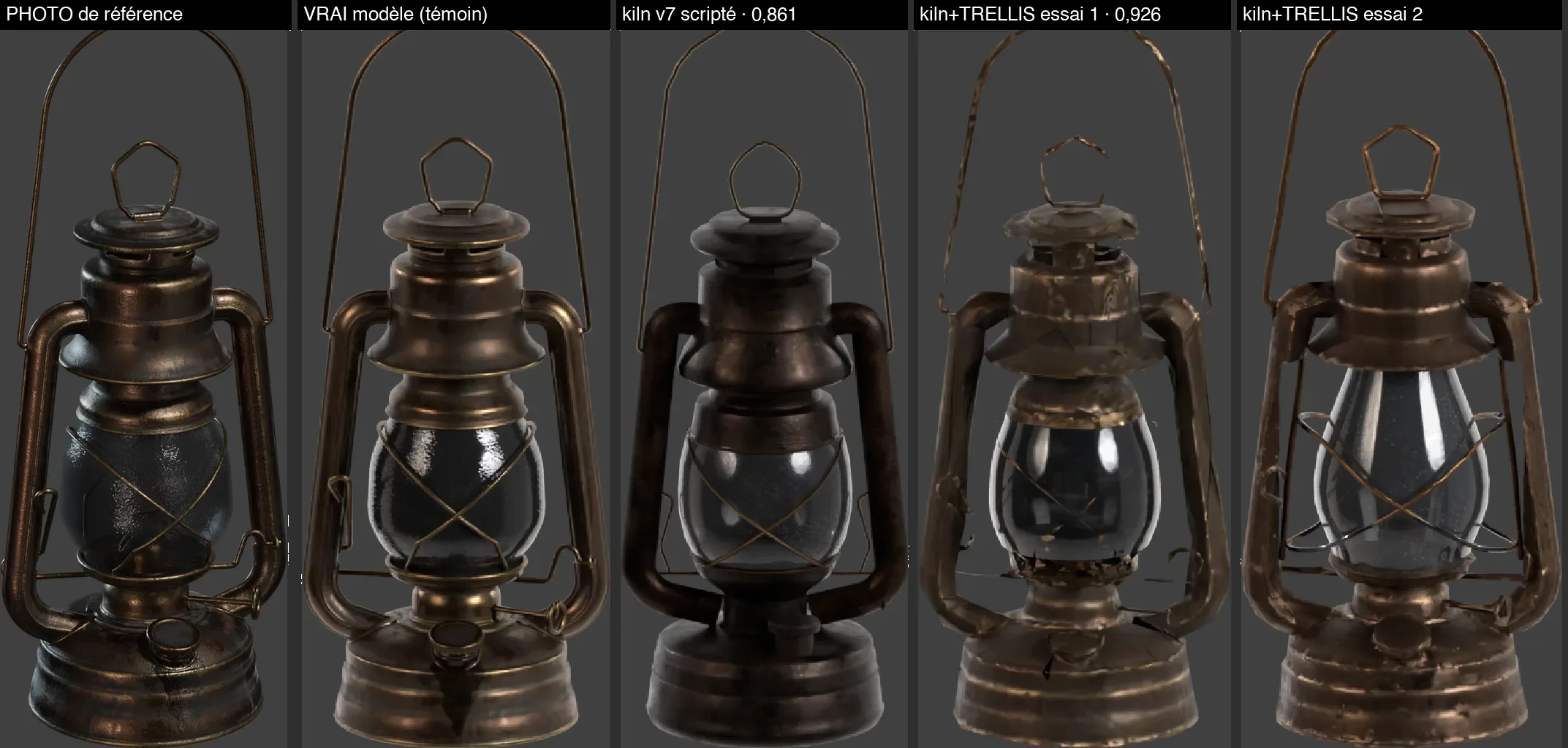
Left to right: the reference photo · the real asset · kiln v7 · kiln finishing the TRELLIS.2 mesh, try 1 · try 2.
Finishing it directly did not work: decimated 97 %, every wire broke (try 1, still 0.926, a
silhouette does not see a hole); rebuilt as curves, the wires held but the surface stayed
faceted and smeared (try 2). Used instead as a measuring template -
plugin/tools/template_profile.py reads its profile within 0.6 mm of
the real object's, it gave the scripted lantern its proportions from v9 on.
8. Keeping the bench honest
- v12 read the answer key. Sessions ran inside the bench's own repository; v12 listed
bench/results/and read a README holding the real lantern's measurements. Its numbers are kept, struck out. The runner now builds a sandbox per session and audits every transcript; v13 to v15 and the crate and chair runs: zero calls outside it. - v10's height was copied, not assumed. An example command in the skill carried the real lantern's height. Removed; the shape scores, scaled to the real height, were not affected.
- A first crate run was lost to the machine sleeping mid-review. Set aside, unmeasured.
What the measurements taught
Each of these is now a rule in the skill, and each came from a number, not an opinion:
- Measure instead of eyeballing. Reviewing by eye, sessions over-corrected twice: too bright and blotchy, then grey at half the reference's saturation.
- Trace thin parts from the pixels. A wire traced from the image lands within 0.7 mm of hand- measured points; a guessed one drifts and kinks.
- Layer texture fields, and give grime a direction. Colour, roughness, relief and cavity as independent fields; streaks along a turned part's profile.
- Settle what one photo cannot say before modeling: the real size, the camera's elevation and azimuth, and more views when the back will be seen.
- Never fit the photo harder than the real object would. Close the listed gaps; stop.
- Measure the file that ships. A float colour bake exported black; only the GLB showed it.
- Scale the procedure to the asset. A background prop does not need eight measures.
- Start the surface from a scan. Rust, paint and wood from CC0 scanned sets, tinted to the photo's palette, read real where procedural noise reads as a smear.
- Proportions from a 3D template when one exists, never its surface, and widths too, since the photo's perspective narrows them.
- Look at every joint. A part that joins another enters it; no distance can judge that, so the review renders each one.
- No figure from a measured object in what a session reads. It becomes a target.
- One material problem per correction round. Six at once regressed the surface.
The full record is in CHANGELOG.md.
Limits
- One run per brief. A model is not deterministic; a difference of a few hundredths between two versions is not significant. No version was repeated to measure that variance, v13 → v14 moved the lantern's shape by 0.04 with no change to how it is modelled.
- Five references. Six fixed briefs, three Poly Haven photos. Two of them are 3/4 views; none is a real photograph of a real object. The lantern also taught the skill: its own score overstates how the skill generalises, the crate and the chair are the fairer test.
- The studio light is not the photo's. Luminance and highlights depend on it, the real asset itself reads +0.05 luminance against its own preview, so those two numbers are alarms, not targets. Saturation and shape held.
- The cloud AI path is not measured end to end. Its free quota is one or two generations a day, and rule 6 stops a headless run at decimation. The local TRELLIS.2 path is measured (§ 7).
- Brass has no scanned set, and the lantern's surface gained less than the crate's and the chair's. Its frame came out a second tone, flagged by the review and shipped anyway.
- The size is an assumption when the brief gives none, and an atypical object gets it wrong.
Reproduce
python3 bench/test_measure.py                          # the instrument first
python3 bench/run.py mylabel                           # the six briefs, each sandboxed; BENCH_MCP=lab for the Lab server
python3 bench/report.py baseline-52 mylabel            # compare with a recorded label
blender -b --factory-startup --python-exit-code 1 --python bench/gt_compare.py -- \
  --truth <poly-haven-asset>.gltf --model <asset>_final.glb --label mine
Needs Blender 4.4+ (measured on 5.2.2), gltf-transform, cwebp, and Claude Code. A session
costs about $1-5 in API-equivalent usage.